Smaller Hoops, Quicker Mercedes: The Real-World Case for 18-Inch Wheels in the UK
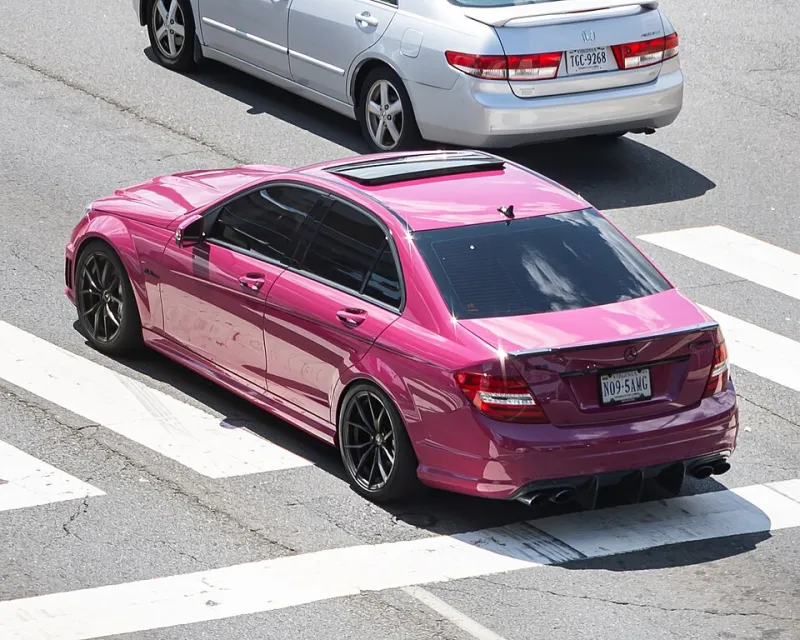
Photo: OWS Photography, CC BY 4.0, via Wikimedia Commons
There’s a certain logic to big wheels. They fill the arches, they make a standard Mercedes look like it’s been to finishing school, and they photograph brilliantly. But if you actually drive your car on UK roads — the sort with patched tar, ragged edges and potholes that appear overnight — the argument for 20-inch hoops starts to wobble. On a tuned Mercedes used for fast B-road blasts and the occasional track day, an 18-inch wheel with the right tyre is often the quicker, cheaper and less painful answer.
This isn’t a purity lecture. Style matters. But the best fast-road Mercedes I’ve driven have rarely been the ones with the biggest wheels. They’ve been the ones with enough sidewall to deal with Britain, enough brake clearance to stay safe, and enough tyre choice to keep the whole thing viable.
Unsprung mass is the enemy you can feel
Wheel and tyre weight sits at the worst possible place: the end of the suspension. Every extra kilo there has to be controlled by the damper and spring, and it also has to be accelerated and decelerated as part of the rotating mass. A heavy 20-inch wheel and tyre combo doesn’t just add gross weight; it adds inertia. On a broken surface, the suspension has to work harder to keep the contact patch planted.
On paper, the difference between a decent 18-inch setup and a fashionable 20-inch one can be a few kilos a corner. In the real world, that’s the difference between a car that settles after a mid-corner bump and one that skips and fidgets. On a C63 or an E63 with stiffened suspension, it’s especially noticeable. The car may ride with more compliance on 18s, but it also tends to breathe with the road rather than crashing over it.
There’s a caveat: cheap 18s are not automatically light. A heavy cast wheel in a smaller diameter can still be a boat anchor. The win comes from choosing a sensible, reasonably light 18-inch wheel — preferably something flow-formed or forged if the budget stretches — and pairing it with a tyre that isn’t absurdly heavy. Smaller isn’t magic. Smaller and well-chosen is.
Sidewall is a suspension component you can’t remap
Modern performance tyres have stiff sidewalls, but they still need some height to do their job. Going from a 30- or 35-profile 20-inch tyre to a 40-profile 18-inch tyre gives the suspension a useful extra layer of compliance. That matters on UK roads because our tarmac is not a billiard table. It’s a patchwork.
More sidewall also gives you a kinder breakaway in the wet. On a greasy roundabout or a damp B-road, a tyre with a bit more vertical give can communicate what the contact patch is doing. Ultra-low-profile rubber often trades that subtlety for steering response. On track that can feel sharp. On a cold, damp morning in the Peak District, it can feel vague and brittle.
This is not an argument for balloon tyres. An 18-inch wheel with a 245/40 or 255/40 tyre is still a properly sporting setup. It just isn’t pretending the road is smooth. On a Mercedes with adjustable dampers, the difference in ride quality is often enough to make the car feel more expensive again — and more usable at speed on imperfect surfaces.
Potholes, kerbs and the cost of fashion
Low-profile tyres protect nothing. The wheel takes the hit. A 20-inch rim with a 30-profile tyre has very little cushion between the road and the alloy, which is why so many big-wheel Mercedes end up with buckle damage, cracks and kerb rash. In the UK, that’s not an occasional risk; it’s a running cost.
An 18-inch wheel gives you more sidewall and, usually, a cheaper replacement tyre. That matters. A set of quality 18-inch performance tyres can be significantly less expensive than the equivalent 20-inch sizes, and they’re more likely to be in stock when you need one. If you’re running a tuned Mercedes on a realistic budget, that saving funds the stuff that actually makes the car quicker: fresh dampers, a proper alignment, good brake pads and decent fluid.
There’s also the question of wheel repair. A buckled 20-inch forged wheel is not a cheap fix. An 18-inch wheel is less exposed in the first place, and if the worst happens, replacement costs are usually more palatable. That’s not glamorous, but neither is a vibration through the steering wheel on the M6.
Brake clearance is the non-negotiable
Here’s where the 18-inch argument needs nuance. Not every Mercedes can run 18s. Big-brake AMG models — particularly cars with large standard discs and multi-piston calipers — may need 19-inch wheels as a minimum. You cannot argue your way around brake clearance. It’s a safety and fitment issue, and it needs checking properly, ideally with a test fit.
On many standard or mildly upgraded Mercedes, 18s clear the brakes comfortably. On others, spoke design matters as much as diameter. A concave 18-inch wheel may clear where a flat-faced one won’t, or vice versa. If you’re buying used wheels, check the brake template, check the offset, and don’t trust an internet post that says “they fit” without context. The aim is a setup that works, not a gamble.
Tyre availability is a genuine performance advantage
In 2026, the 18-inch performance tyre market is still deep. You can find proper summer rubber, capable all-seasons and track-focused options in common sizes. That choice matters. It means you can pick a tyre that suits your use rather than whatever happens to exist in a rare 20-inch size.
For a UK Mercedes, that often means a good premium summer tyre for fast-road use, with a separate set of wheels for winter or all-season duty if the car is used year-round. It also means track-day tyres are more accessible. An 18-inch track tyre is usually cheaper, and you can carry a spare set without feeling like you’re transporting furniture.
Narrower 18-inch setups can also help in the wet, because a slightly narrower tyre can cut through standing water more effectively than a wide, low-profile one. That’s not a universal rule, but it’s a useful consideration for a car that sees real British weather.
The track-day reality check
On a smooth track, big wheels can work. They can look fantastic and offer huge brake clearance. But most UK track days are not smooth, and many are wet. An 18-inch setup with a sensible tyre gives you more warning before grip disappears, more compliance over kerbs and curbs, and cheaper consumables.
If you’re doing a handful of track days a year in a tuned Mercedes, you don’t need the ultimate show-wheel spec. You need a setup that survives the drive there, performs consistently and doesn’t ruin the car on the way home. An 18-inch wheel with a quality tyre is often the more mature fast-road and track compromise.
A sensible 18-inch recipe
Start with fitment. Confirm brake clearance, offset and load rating. Don’t go wider than the car needs. A square setup can be useful for track work and tyre rotation, while a mild stagger keeps the rear axle planted in a powerful rear-drive AMG. Pick a tyre with a proper performance pedigree rather than a budget brand with a sporty name. Get the alignment done after fitting, and check ride height if you’re on coilovers.
Most importantly, don’t treat 18s as a downgrade. Treat them as a deliberate choice. On a UK Mercedes, smaller wheels with the right rubber often make more sense than 20s. They ride better, cost less to run, survive potholes with more dignity and — on the right road, in the right conditions — they’re genuinely quicker. The 18-inch argument isn’t about being sensible. It’s about being fast where it counts.