Ghost Air: How to Smoke Out Boost Leaks on a Tuned Mercedes
There is a particular kind of disappointment that follows a remap. You collect the car, enjoy the first few pulls, and then notice that it does not feel quite as sharp as it did on the dyno graph. Sometimes the answer is heat soak, fuel quality or unrealistic expectations. Quite often, though, it is air escaping from somewhere it should not. On a tuned Mercedes, a boost leak is the quiet thief of performance. It rarely announces itself with a dramatic breakdown. It just nibbles away at response, economy and your confidence in the car.
The symptoms are often polite
A small boost leak can feel like a car that is simply having an off day. You might notice a faint hiss or whistle under load, a softer mid-range, or a top end that arrives with less shove than before. Fuel economy can drop because the engine is working harder for the same road speed. Some owners report a slightly uneven idle or a puff of black smoke under hard acceleration, especially on older turbocharged AMGs and tuned four-cylinder cars.
The tricky part is that the fault codes can be misleading. A P0299 underboost code is the obvious one, but you may also see fuel trim codes, a generic intake leak code or nothing at all. A mild leak on a car with a fresh map can hide behind adaptations and keep the dashboard clean. That is why it pays to treat a loss of edge as a physical problem first, not automatically as a mapping issue.
Where tuned Mercedes actually leak
The usual suspects are not glamorous. Intercooler hoses crack from the inside out. Charge pipe couplers soften, swell or slip off their beads. Plastic intake manifolds and resonator chambers develop hairline splits. O-rings flatten. Diverter valves and PCV hoses go porous. On older UK cars, corroded clips and alloy fittings add another layer of misery, particularly around the front end where road salt and grit collect.
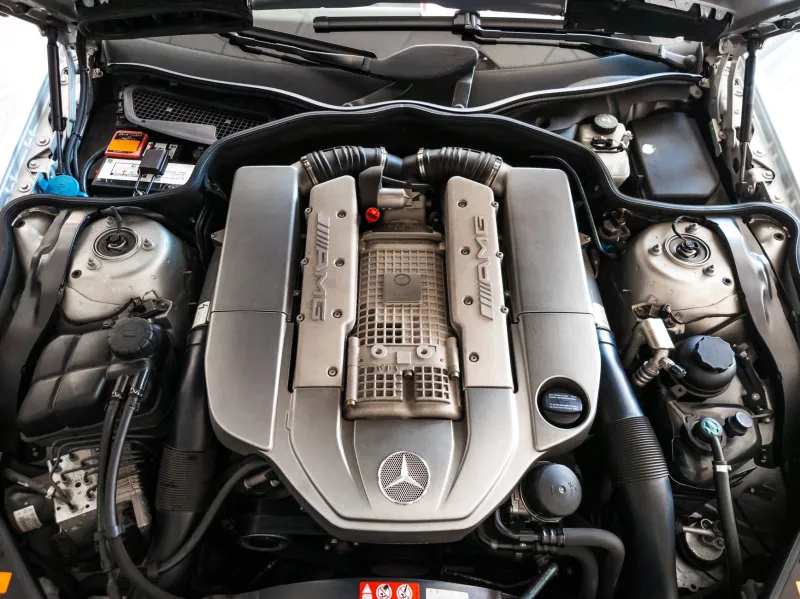
On M274 and M276 engines, the charge pipe joins and intercooler end tanks are worth a close look. On M133 cars, the short, busy intake tract gives you plenty of joints to inspect. Older V8s have their own favourites, including vacuum lines and breather hoses that have baked hard over years of heat cycles. Anything downstream of the airflow meter but upstream of the engine can admit unmetered air or lose metered air under boost, and both scenarios upset the fuelling calculations.
UK conditions accelerate the process. Summer heat cycles harden rubber, winter salt attacks fasteners and brackets, and the generous undertrays that keep motorway filth off the engine also trap damp grit against pipes. A car that spent its life on the coast or in a salty county deserves a proper inspection before you blame the software.
Smoke testing without drama
A smoke test is exactly what it sounds like: you introduce visible smoke into the intake tract and watch where it escapes. A proper workshop smoke machine is ideal, but there are affordable DIY units and adapter kits that work well enough for a home inspection. You will also want a torch, a mirror on a stick, some clean rags and a phone camera to film awkward areas while you are under the bonnet.
The basic procedure is to cap the intake where it makes sense, connect the smoke source to the charge pipe or intake tract, and gently introduce smoke. Do not use full compressor pressure. A couple of psi is plenty for finding leaks, and you are not trying to pressure-test the engine like a brake system. With the smoke running, work your way along every joint, looking for wisps coming from couplers, seals, plastic seams and vacuum connections. A soapy water spray can help confirm a suspected leak under low pressure, but keep it away from electrical connectors.
If you have a scan tool with live data, watch fuel trims and boost actual versus requested while a helper holds a steady throttle. That will not pinpoint the leak, but it tells you whether the car is behaving like a boost-leak car rather than a sensor-failure car.
Do not ignore the small stuff
A leak that only appears when hot is still a leak. Heat expands plastic and softens rubber, so some splits open up only after a spirited drive. If the first smoke test shows nothing, repeat it with the engine warm and the intake system at normal operating temperature. Also check the intercooler itself for stone damage and the pipework around the crash bar for scuffs and corrosion.
Be sceptical of quick fixes. Zip ties and extra clamps can get you home, but they are not a long-term answer on a tuned car running more boost than standard. A replacement hose with the correct profile and a clean sealing surface is money well spent. When you refit couplers, make sure the beads are seated and the clamps are tight without crushing the pipe. A leak fixed badly is just a future leak with a story.
The cost of chasing the wrong problem
A boost leak can make a perfectly good remap feel weak. Owners sometimes respond by booking another mapping session, buying a bigger intercooler or blaming the fuel. In the worst cases, a persistent leak pushes the turbo to work harder than it should, raising temperatures and stress. Finding it early is cheaper than a new turbo and far less annoying than paying twice for diagnostics.
Once the leak is fixed, clear the codes and let the car relearn its fuel trims over a few journeys. Recheck boost behaviour on a dry road and make sure the repair has not introduced a new whistle or vibration. If the car still feels flat, then it is fair to look at the map, the sensors and the fuel quality in that order.
For UK owners, a smoke test is a sensible seasonal habit, especially after winter. It takes less time than a tank of fuel and it can save you from a wild goose chase through the mapping world. Ghost air is easy to miss. Once you have seen it curl out of a tired intercooler hose, you will never quite trust a clean fault-code list again.