Silencer Diplomacy: How to Build a Performance Mercedes Exhaust That Still Clears an MOT
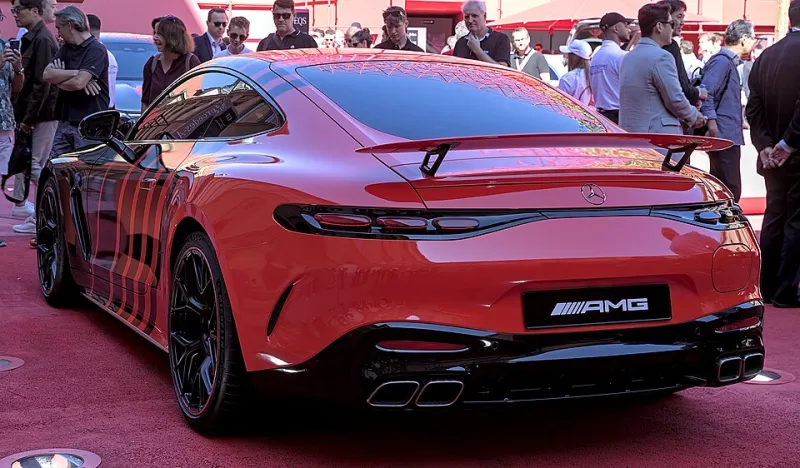
Photo: Alexander-93, CC BY-SA 4.0, via Wikimedia Commons
There is a particular kind of UK Mercedes owner who wants the V6 or V8 to clear its throat on a Sunday morning but still sail through the MOT in February without a raised eyebrow from the tester. That is not an unreasonable goal. It is just one that requires more thought than ordering the loudest cat-back you can find and hoping for the best.
The MOT is not a sound-meter contest. It is also not a free pass to run a straight pipe with a fancy tip. The sensible route sits between those extremes, and it starts with understanding what the test actually looks at.
Start with what the MOT actually checks
The tester is not standing behind your car with a calibrated decibel meter. The MOT looks at the exhaust system's condition and security, checks for serious leaks, and assesses whether the car is excessively noisy. It also runs the emissions test where applicable. A missing or obviously defective emissions component can turn a routine test into a very long conversation.
That does not mean noise is ignored. The Construction and Use Regulations require the exhaust and silencer to be maintained in good working order and not altered to increase noise. If your C-Class sounds like a touring car leaving a supermarket car park, you may attract attention from the police as well as the MOT station. The test is a checkpoint, not a licence to ignore the broader law.
The decibel question: road legal versus track legal
Aftermarket systems often advertise themselves as EC-approved or road legal. Read the paperwork carefully. Approval is usually tied to a specific vehicle, engine and system. A universal back box with a generic certificate is not the same thing. Keep the documentation, because it is useful if you are asked questions at an MOT, by an insurer, or at a track day.
Track days have their own rules. Many UK circuits enforce static noise limits somewhere between 95 and 105 dB, and some are stricter than others. A valved exhaust can help here, but only if the valves are actually closed when they need to be. A system that is quiet on the button but deafening on a cold start is still a problem on a residential street at 6am.
Catalysts, GPFs and the emissions trap
This is where a lot of cheap performance exhaust plans fall apart. Modern Mercedes petrol engines often run a petrol particulate filter, or GPF, as well as a catalytic converter. Removing either is not a shortcut to power. It is a shortcut to emissions failures, warning lights, and a car that is harder to sell.
A cat-back system is usually the sensible starting point. It changes the sound after the emissions equipment without touching the parts that keep the car legal. A turbo-back system can deliver more noise and more flow, but it puts the catalyst and GPF question front and centre. A sports catalyst may work on some cars, but it is not a guarantee of passing an MOT emissions test, especially on a modern Euro 6 engine. GPF deletion is not a cheeky tweak; it is a compliance problem.
If you are buying a used system, check what it replaces and whether the original emissions parts are retained. Keep your standard parts if you have the storage space. They are useful for resale and for troubleshooting.
Valves, resonators and the drone problem
A valved rear silencer is one of the best compromises for a UK performance Mercedes. Closed, it behaves like a sensible touring car. Open, it gives you the soundtrack when conditions allow. The quality of the valve mechanism matters. Cheap systems can rattle, seize, or develop a drone that makes motorway journeys miserable.
Drone is the hidden cost of a loud exhaust. A system that sounds brilliant at 3,000 rpm in a tunnel can be unbearable at 70 mph on the M1. Resonators and Helmholtz chambers are not marketing fluff; they are how decent systems manage the boom. If you do a lot of motorway miles, be honest about what you can live with.
Choosing a system that behaves
A good UK-focused recipe is a cat-back system with a valved rear silencer, retaining the standard catalyst and GPF. Choose a reputable brand with UK fitment support, and use a specialist who understands Mercedes platforms. Check the mounts and bushes as well as the pipework. A system that hangs badly will knock, leak, or crack.
Avoid straight-pipe conversions, fake valve controllers that default to loud, and anything that triggers a check-engine light. A warning light is not a personality trait. It is a fail waiting to happen.
Paperwork, insurance and resale
Declare the exhaust to your insurer. A performance exhaust is a modification, and an undeclared one can cause problems if you need to claim. Keep receipts and approval documents. When you sell the car, a well-documented system from a known brand is easier to explain than a mystery pipe with no history.
A sensible checklist for 2026
- Retain the catalyst and GPF unless you have a proven, legal replacement.
- Choose a valved system that defaults to quiet.
- Check the static noise level if you plan track days.
- Make sure there are no warning lights or emissions faults.
- Use proper mounts and check for leaks after fitting.
- Declare the modification to your insurer.
- Keep the standard parts and paperwork.
The best performance exhaust on a UK Mercedes is not the loudest one. It is the one that sounds expensive when you want it to, stays civil when you need it to, and does not turn MOT day into a drama.