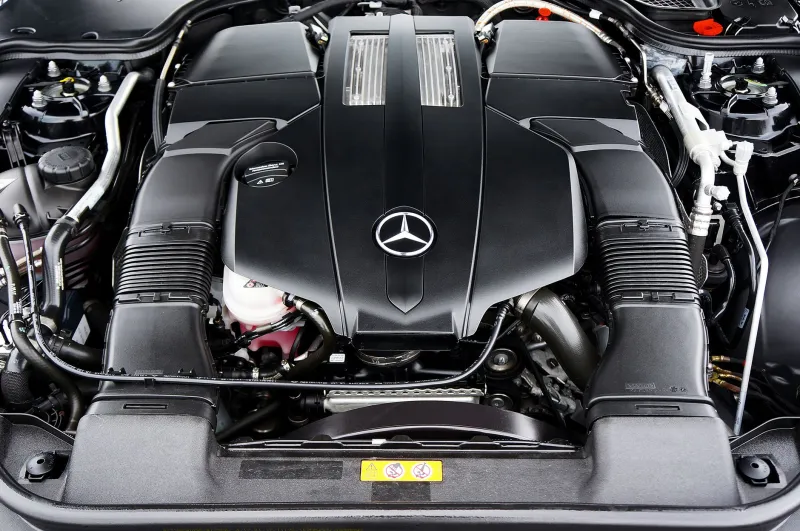
Torque With Receipts: A UK Owner's Plan for a Fast, Legal OM642 Mercedes

Photo: Andy / Andrew Fogg from near Cambridge, UK, CC BY 2.0, via Wikimedia Commons
Diesels have had a rough press in Britain, and some of it is deserved. But if you have ever pointed a healthy C350 CDI or E350 CDI at a damp A-road and used the mid-range shove to dispatch a dawdling hatchback, you will know why the OM642 still has a cult following. It is not a screaming AMG V8. It is something else: a lazy, torque-rich, long-legged engine that makes ordinary UK journeys feel a lot less ordinary.
The catch is that the OM642 is also a middle-aged V6 diesel with a few well-known habits. Tuning one properly is less about chasing a headline figure and more about making sure the car can actually support the extra load. Think of it as a renovation, not a remap alone.
Why the OM642 still makes sense in 2026
A used 3.0-litre diesel Mercedes — C350 CDI, E350 CDI, or the equivalent GLK/ML-era OM642 cars — is still remarkable value. You get rear- or four-wheel drive, a proper automatic, decent brakes and a chassis that was built for motorway miles. Fuel costs are no longer the bargain they were, but a well-maintained example can still return sensible UK cruising economy.
The performance angle is simple. The OM642 makes its best work between 1,600 and 3,000 rpm, exactly where British roads live. You do not need to rev it to the moon. A good Stage 1 map simply leans on that already generous mid-range, adding perhaps 30-45 bhp and a useful chunk of torque depending on the base engine and condition.
On a C350 CDI, that can mean something close to 300 bhp and 700 Nm. That is plenty. It is also the point where you need to stop and ask what the gearbox, cooling system and DPF think about your plans.
The maintenance bill comes before the map
This is the bit that separates a good diesel tune from an expensive one. Before anyone flashes the ECU, the car needs a proper health check. The OM642 has several known weak points and a remap will find them.
Start with the oil cooler seals. They are a known leak point on older examples, and the job is labour-heavy because the intake and associated gubbins have to come off. If yours is weeping, fix it first. Fresh boost pressure and a leaking oil cooler are not a good combination.
Next, look at the intake system. OM642s carbon up their inlet tracts and swirl flaps over time. A borescope inspection or inlet-off clean can tell you a lot. If the flaps are gummed solid or the intake is heavily coked, a remap is just adding stress to a breathing problem.
Then there is the turbo. Check for actuator wear, boost leaks and oil seepage. A smoke test is worth the money. So is a live-data check of requested versus actual boost. If the turbo is tired, a Stage 1 file will finish it off quickly.
Do not forget the gearbox. The 7G-Tronic is a decent unit, but it is not indestructible. A fluid and filter service at the right interval is cheap insurance. If your car has a patchy service history, budget for it before you add torque. The same goes for the differential and transfer case on 4MATIC models.
Finally, check the DPF. A diesel particulate filter that is already half-blocked will not thank you for more fuelling. Look at ash mass and backpressure readings. A forced regeneration is not a cure for a worn-out filter.
Stage 1: the sensible target
A good OM642 Stage 1 should feel like a stronger version of the standard car, not a dragster. You want a smooth, linear pull from low revs, clean running and no heavy smoke. Anyone offering wild torque figures without asking about the gearbox, DPF or service history is selling you a problem.
Ask the tuner what they are doing about torque limiting in lower gears. Some maps are deliberately soft in first and second to protect the gearbox. That is a good sign. Ask for a before-and-after dyno plot if possible, and make sure the file is written to your car rather than bought off a shelf.
Also think about cooling. The OM642 is not as heat-sensitive as a tuned petrol AMG, but a clogged radiator, tired fan or failing thermostat will show up under load. A £40 thermostat is cheaper than a warped head.
DPF and EGR: the legal line
This is where UK owners need to be honest with themselves. Removing or gutting a DPF on a road car is not a cheeky tuning mod. It is an offence, it can fail an MOT on the visual check, and it can invalidate your insurance if it is not declared. The same applies to EGR delete maps that are sold as 'off-road only' but used on the school run. The MOT smoke test is not a full emissions test, but it can still catch a badly tuned diesel, and enforcement is getting sharper.
You can legally tune an OM642 with the emissions kit intact. The trick is to make sure the DPF is healthy and the EGR system is working as intended. If the EGR is clogged, clean or replace it. If the DPF is ash-loaded, replace it. Do not map around a failing emissions system and call it a performance upgrade.
The UK verdict
A sorted OM642 Mercedes is still one of the smartest fast-road buys in Britain. It is not a track toy, and it will never sound like an M156. But for a car that has to do motorway, B-road and winter commuting duty, the combination of torque, comfort and real-world pace is hard to beat.
Just remember the order of operations: maintenance first, diagnostics second, map third. Do that and the diesel renaissance makes sense. Skip it and you will be paying for someone else's shortcut.